
Stuck Bitcoin Transfer? Read the Size and Fee Rate First
A transfer that sits unconfirmed is almost always a fee-rate problem, and the accelerator's rules are written in exactly those units. The free route needs a transaction of 0.5 KB or less paying at least 0.0001 BTC/KB, submitted while the hourly quota lasts. For a miner at 75 TH/s earning $2.85 a day, that floor is real money: half a kilobyte at the minimum rate carries 0.00005 BTC of fee, about $4.23.

Key takeaways
- Free eligibility has two conditions at once: size at or under 0.5 KB and a fee rate of at least 0.0001 BTC/KB.
- Free slots refresh hourly and are handled first-in-first-served, so a submission can miss the quota.
- The paid route accepts BTC, BCH or LTC, with the charge taken from the account balance.
- Once accepted, the transaction is non-cancellable and the fee is not refunded, even if you change your mind.
Why a pool can move a transaction at all
Bitcoin miners order the transactions inside each block, and they order them by fee rate. A pool that mines a block can therefore place a chosen transaction near the front of its own block. That is the whole mechanism behind acceleration: no second transaction, no replacement, no special channel to the network — just priority inside a block that the pool is about to produce.
The ViaBTC TX Accelerator runs this as a tool rather than a favor, with published conditions and a queue. The queue matters because the tool is popular and the free capacity is finite per hour. A submission that arrives after the quota is used waits for the next window, which is a different kind of delay from the one the sender was trying to fix.
The two numbers that decide eligibility
Size is measured in kilobytes, not in dollars, and a standard single-input, two-output payment is roughly 0.22 to 0.25 KB. Multi-input transactions grow with each input, so a wallet that consolidates many small coins can cross the 0.5 KB line without the sender noticing. Fee rate is the fee divided by that size, expressed per kilobyte, and it is the number that determines whether the free route is open.
Both conditions apply together. A tiny transaction paying a low rate fails on rate; a generously funded transaction of 0.9 KB fails on size and has to use the paid option. Checking the two figures before submitting saves a rejected attempt and, more importantly, saves the wait while a quota window closes.
What the minimum rate actually costs
At 0.0001 BTC/KB, a 0.25 KB payment carries 0.000025 BTC of fee, about $2.12 at $84,692. A 0.5 KB transaction at the same rate carries twice that, $4.23. Whether those amounts feel large depends entirely on what is being moved: a $2.12 fee against a $50 payment is four percent, against a $5,000 payment it is nothing.
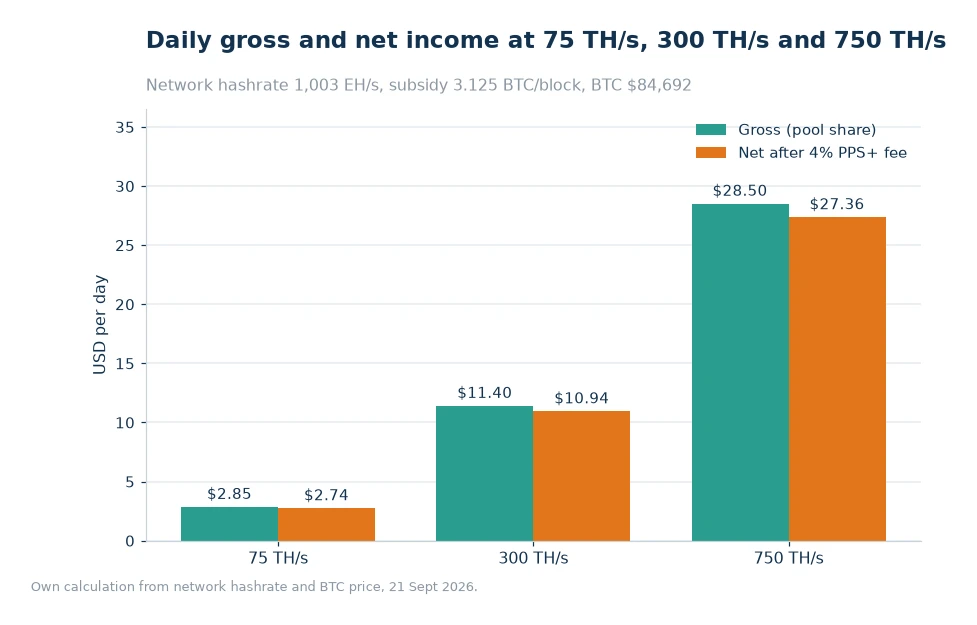
For a small miner the comparison is with daily production. At 75 TH/s the account credits $2.85 a day gross, $2.74 after the listed 4% on the block-reward component, so a 0.5 KB transfer at the minimum rate costs more than a day of mining. At 750 TH/s the same transfer is a fraction of a day's $28.50. The tool's price does not change with hashrate; the miner's tolerance for it does. The Profit Calculator returns that daily figure for any hashrate you type in, which is quicker than repeating the division by hand.
Using the account balance instead of a wallet
The paid route is settled in BTC, BCH or LTC straight from the account, which removes the awkward step of funding a fee from the same wallet that is waiting on the stuck transaction. That detail is more useful than it sounds: when a wallet has no confirmed coins left, it cannot easily pay to unstick itself, and a second funding source is the practical answer.
Keep a small balance in the account for exactly this purpose. The multi-currency wallet holds the payout balance and the fee currency in one place, so acceleration can be paid without a deposit arriving first. Withdrawal of mining income itself carries no fee, which means the balance is not quietly eroded by moving coins in and out.
What the tool will not do
Acceleration is not a guarantee of a timestamp. The promise is inclusion in the next block the pool mines, and how soon that block arrives is a matter of the pool's own hashrate against the network. It also refuses double-spends, and it will not touch a transaction whose inputs are still unconfirmed — the parent has to be mined first, which is why a wallet that chained two payments can leave the sender feeling stuck twice.
There is no undo either. A request cannot be cancelled after submission and the fee is not returned, so a mistyped transaction ID or a duplicate submission is money spent for nothing. Read the confirmation screen carefully, and submit the actual stranded transaction rather than the one you meant to send. These limits are ordinary for a priority tool, but they are the ones people discover after the fact rather than before.
Four transactions, four routes
The table runs four common profiles through the rules. Sizes and rates are illustrative, chosen to sit either side of each threshold, and the dollar column prices the fee at $84,692.
| Profile | Size | Fee rate | Route |
|---|---|---|---|
| Single payment, modest fee | 0.25 KB | 0.00012 BTC/KB | Free, if quota remains; fee $2.54 |
| Single payment, thin fee | 0.25 KB | 0.00004 BTC/KB | Paid option; free route fails on rate |
| Consolidation of many inputs | 1.10 KB | 0.00030 BTC/KB | Paid option; free route fails on size |
| Half-kilobyte transfer at the floor | 0.50 KB | 0.00010 BTC/KB | Free, exactly at both limits; fee $4.23 |
Worked example
Price the free threshold against a small mining account, step by step.
- Divide the daily 450 BTC issuance by 1,003,000,000 terahashes: 0.00000044865 BTC per TH/s.
- 75 TH/s: 75 × 0.00000044865 = 0.0000336488 BTC a day.
- Gross dollars: 0.0000336488 × 84,692 = $2.8498, rounded to $2.85.
- After the listed 4% on the block-reward component: 2.8498 × 0.96 = $2.7358, rounded to $2.74.
- Minimum free-route fee on 0.5 KB: 0.5 × 0.0001 = 0.00005 BTC.
- That fee in dollars: 0.00005 × 84,692 = $4.2346.
- Days of gross income needed to cover it at 75 TH/s: 4.2346 ÷ 2.8498 = 1.49 days.
- At 300 TH/s the same fee equals 0.37 of a day; at 750 TH/s, 0.15 of a day.
Frequently asked questions
What makes a transaction eligible for free acceleration?
Two conditions: the transaction must be 0.5 KB or smaller and must pay a fee rate of at least 0.0001 BTC/KB. Meeting both still depends on the hourly quota having room when the request is submitted.
Can a submitted acceleration be cancelled?
No. Once a request is accepted it cannot be withdrawn, and the fee is not refunded. Confirm the transaction ID and the amount before submitting rather than after.
What happens if the transaction has unconfirmed inputs?
It cannot be accelerated until those inputs confirm. The practical step is to accelerate the earlier transaction first and wait for it to be mined, then submit the child.
Submit once, with the numbers in hand
Open a block explorer, read the virtual size and the fee rate, and put those two figures beside the thresholds before touching the form. If both pass, submit early in the hour rather than late, because the queue is first-in-first-served. If either fails, decide whether the delay costs more than the paid route before spending anything. The transaction accelerator explains its own rules on the page, and reading them takes less time than a rejected submission.
Accelerator rules and fee options from the ViaBTC tool page, read 21 Sept 2026[1]; at that date the network ran at 1,003 EH/s with a 3.125 BTC subsidy and the coin near $84,692. Published 24 Oct 2026. Profile sizes and rates in the table are illustrative, and dollar values are arithmetic on those inputs.